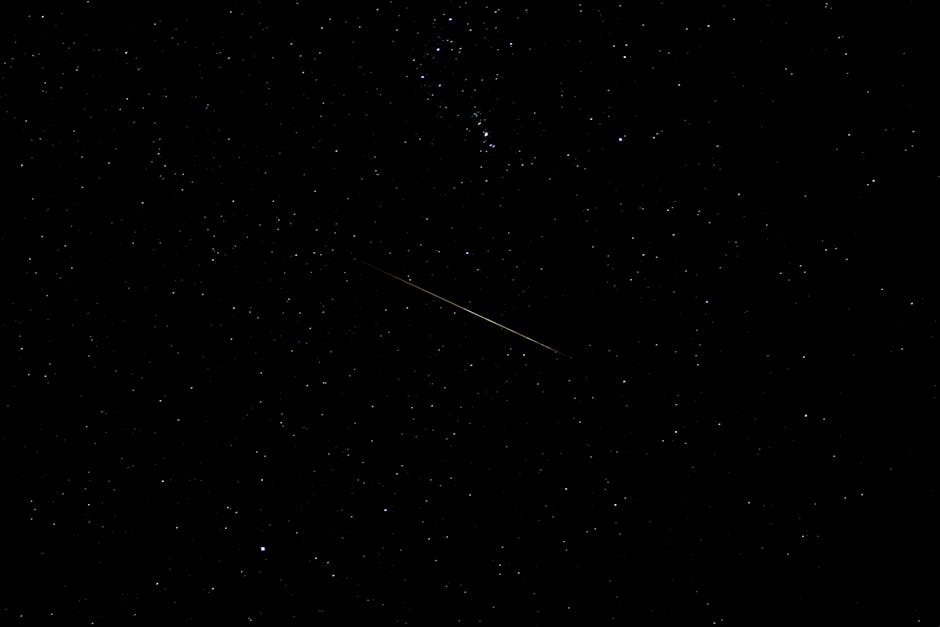
Ancient stardust falls through December skies, carrying messages about who we are and what we might lose
There is something profoundly unsettling about standing alone beneath a meteor shower. I remember my first encounter with the Geminids twenty winters past, lying flat against frozen Pennsylvania soil until my breath formed ice feathers on my scarf. One meteor sliced the sky, then two, until the heavens seemed to crack open, scattering diamond dust across the void. In that silent avalanche of light, I felt simultaneously insignificant and deeply connected to everything that exists. Few natural phenomena retain this power to humble modern humans, who so rarely look up from glowing rectangles to consider older forms of illumination.
This year's Geminid meteor shower, peaking around December 13, arrives under exceptionally favorable celestial conditions. A waning crescent moon will not intrude upon the darkness, granting urban refugees and rural dwellers alike a rare opportunity to witness nature's grandest performance art. Such ideal circumstances only occur every few years, making this display particularly precious. At their height, these rocky fragments from asteroid 3200 Phaethon wander into Earth's atmosphere at 78,000 miles per hour, slower than most meteors, allowing their trails to linger like chalk marks on a cosmic blackboard. These bright, persistent streaks distinguish the Geminids from other showers.
Few appreciate the geological oddity that makes this possible. While most meteor showers originate from icy comets that shed debris like cosmic breadcrumbs, the Geminids spring from an asteroid with comet like qualities. 3200 Phaethon straddles classifications, emitting dust during rare solar approaches while maintaining a predominantly rocky composition. Some planetary scientists now speculate it might be the dead husk of a comet that exhausted its volatile materials, or perhaps a fragment from the stony asteroid Pallas. The implications are startling, if true. We might be watching the cremation of a cosmic body that transformed itself millions of years before human consciousness arose to interpret the spectacle.
Consider the cultural weight carried by these falling stars. Ancient Greek astronomers linked the December meteors to the doomed chariot ride of Phaethon, son of Helios, who scorched the earth before Zeus struck him down with lightning. Chinese records from 36 AD meticulously documented 'over a hundred falling stars between midnight and dawn,' likely the earliest account of our beloved Gems. The Maya saw meteors as the cigar ashes of celestial gods, the Algonquin peoples as sky spirits rearranging their campfires. Every culture projected meaning onto these lights, revealing less about the cosmos than about our own need for narrative coherence.
Here arises our modern tension. Never before have we understood meteor showers with such crystalline scientific precision. Automated systems like NASA's All Sky Fireball Network track each Geminid entry, measuring mass, velocity, and orbital trajectory with uncanny accuracy. Citizen scientists contribute thousands of meteor reports through smartphone apps, generating real time density maps. Yet simultaneously, we've engineered an environment where direct experience of celestial wonders grows increasingly rare. Global light pollution increases annually by 2, dimming all but the brightest stars for 80 percent of humanity. The irony stings. Our tools decode the universe's secrets while our cities blind us to its beauty.
The true revelation during any Geminid vigil comes not from counting streaks across the sky, but from recognizing the fragile cosmic conditions that allow us to witness them. Earth's perfect atmospheric density transforms Phaethon's debris into luminous trails rather than silent space rocks or catastrophic impacts. The shower's mid December timing ensures long nights conducive to prolonged viewing. Even our planet's axial tilt plays its role, positioning northern hemisphere observers under the optimal meteor radiant point. These coincidences shape our experience far more than most star gazers realize.
Commercial endeavors increasingly exploit these celestial rarities. Affiliate linked telescope recommendations now accompany nearly every meteor shower announcement. Dark sky tourism boosts remote economies, while light pollution continues largely unchecked near population centers. We package cosmic wonder into weekend getaways and gear bundles, soothing our ecological conscience with consumerism. Yet for all our technology and telescopic sophistication, an inconvenient truth persists. Nothing replaces lying quietly beneath an open sky, allowing peripheral vision to absorb the meteors your focused gaze might miss. It demands patience our digital society undervalues.
Perhaps the Geminids' greatest lesson involves geological time scales. 3200 Phaethon completes its orbit every 1.4 years, yet the debris stream causing our December display represents millennia of accumulated disintegration. Each meteor is a chip from a celestial sculpture slowly eroding since before human agriculture began. Someday, as the asteroid crumbles completely or Earth's orbit subtly shifts, the Geminids will cease. Other meteor showers have disappeared from our skies within recorded history, like the Andromedids that dazzled 19th century observers before diminishing. This impermanence makes the spectacle more poignant.
Some communities grasp what's at stake. Flagstaff, Arizona became the world's first International Dark Sky City in 2001, implementing lighting ordinances that preserve their million dollar view of the cosmos. Their economic revitalization through ethical ecotourism proves darkness has value beyond astronomy. Conversely, Satellitemap.space reveals over 5,000 active satellites now crisscrossing the night, their metallic glare increasingly interfering with astronomical observation. The Geminids still pierce through, for now, but future generations may inherit dimmer skies.
So bundle against the cold this December, not merely to check off nature's spectacle, but to confront deeper questions. Are we caretakers or consumers of cosmic beauty. Can technological progress coexist with preserving primal experiences. Within each meteor's fleeting glow lies an invitation to realign our priorities. The miracle isn't that rocks fall from space. The miracle is that evolved apes on a fragile blue planet can look up, connect dots across millennia, and feel wonder. That remains our most endangered natural resource.
 By David Coleman