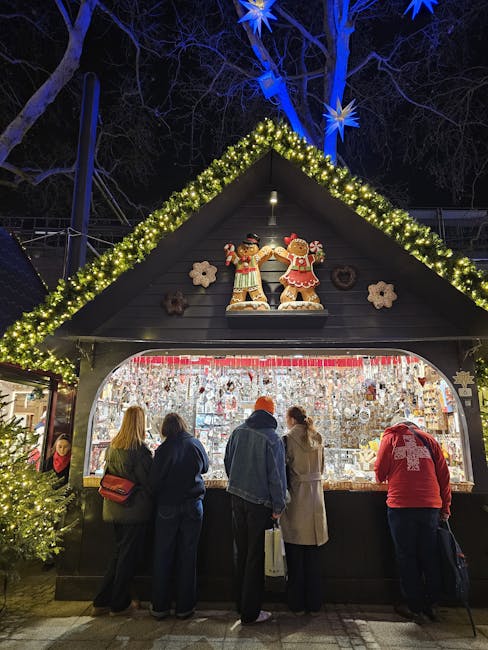
Concrete proof that even Christmas requires 21st century armor
There's an existential gag about municipal workers in Augsburg, Germany who now perform a daily Advent ritual involving hand cranks, crane machinery, and 770 pound steel bollards. Each time a tram approaches their city's famed Christmas market, these modern day steelworkers become accidental performance artists as they raise and lower the barriers like gruff angels heralding mass transit. One might call it festive security Kabuki if the stakes weren't so soberingly real. At least three European Christmas markets have suffered vehicular attacks since 2016, turning Germany's beloved seasonal gatherings into soft targets necessitating hard defenses.
The Augsburg market, a 500 year old tradition interrupted only by world wars and pandemics, now boasts infrastructure more commonly found outside embassies or nuclear power plants. Visitors who once admired hand carved nativity scenes now gawk at hydraulic bollard removal techniques performed with the frequency of cuckoo clock chimes. Locals whisper that civic planners briefly considered installing festive red and green barriers before choosing gunmetal gray on the basis that terror cells don't respect color coordination.
Germany's approach to yuletide security exemplifies Europe's precarious dance between cherished public traditions and 21st century threat matrices. While congressional hearing rooms across America debate theoretical security theater concepts, German town squares enact concrete solutions that would give OSHA officials nightmares. Their Christmas market blueprints now resemble medieval castle schematics, with chokepoints, barriers, and surveillance outposts encircling glühwein vendors like electronic moats. This produces a peculiar cognitive dissonance where children nibble lebkuchen cookies mere feet from crash rated steel poles capable of stopping a seven ton truck traveling 40 miles per hour.
The engineering marvels come at operational cost. Market operators deploy portable x ray scanners and employ security personnel to wand grandmothers carrying knitting needles deemed potential improvised weapons. Vendors jockey for stall positions strategically distant from emergency service access points. Souvenir mug designs now incorporate evacuation route maps alongside depictions of the Christmas pyramid. This fusion of holiday kitsch and civil defense planning creates a uniquely Germanic form of gallows humor. As one Berlin security consultant joked during a recent panel discussion, We've perfected making public spaces simultaneously welcoming and impregnable. Come for the stollen cake, stay because our bollards immobilized your vehicle.
Yet beneath the dark comedy lies a profound societal choice. German interior ministry studies reveal that 68% of citizens support visible security measures at large gatherings despite aesthetic objections. This public pragmatism reflects Europe's fraught relationship with mass casualty events, from the 2016 Berlin market attack to recent incidents in France and Austria. When questioned about the cumbersome bollard systems, Munich's head of public safety offered a philosophical shrug. Better to have clunky protection than elegantly memorialized victims, she told reporters during this year's market inauguration ceremony.
The financial burdens are nothing to sneeze at either. Augsburg's crane operated bollard system alone cost €400,000 to install, with annual maintenance budgets exceeding €70,000. Across Germany, municipalities collectively spend over €12 million each December transforming picturesque town squares into temporary fortresses. Security experts advocate for permanent subterranean bollards rising from the pavement at push button command, but many communities balk at the €1.3 million per installation price tag. This creates a patchwork approach where wealthy cities resemble maximum security facilities while smaller towns rely on parked municipal vehicles as makeshift barriers.
Cultural psychologists observe fascinating behavioral shifts arising from these visible precautions. Market visitors develop unconscious strategies like positioning themselves near bollards when queuing for bratwurst, creating human clusters around the very structures meant to protect them. Vendors report increased sales of durable goods near perimeter areas, suggesting shoppers subconsciously prefer escape route adjacency. Even children's perception of public space transforms, with kindergarten teachers noting pupils incorporate security barriers into drawings of Santa's workshop alongside traditional chimneys and reindeer.
What emerges from this tension between tradition and security is perhaps Europe's most honest Christmas metaphor. The markets now literally embody peace through strength, offering mulled wine and stollen cakes protected by enough reinforced concrete to make a bunker blush. The once ephemeral holiday magic becomes anchored by immutable physical objects, as if Dickens' Ghost of Christmas Yet to Come collaborated with a civil engineering firm. American observers might find this jarring, forgetting that Germany's famous festive spirit was forged in the same historical fires that necessitated such vigilance.
Ultimately, the Augsburg bollards represent neither surrender nor paranoia, but rather stubborn resilience. The Christmas market persists not despite security measures, but through their calculated implementation. Each cranking of that hand operated crane reinforces a cultural truth as old as the markets themselves: communities determined to gather will always find ways to do so safely. Visitors still laugh, couples still kiss beneath mistletoe, and children still press noses against toy shop windows. They just do it with the quiet understanding that ramparts have always been part of human celebration, whether built from ancient stones or modern steel.
German officials hope someday to retire the bollards to museum exhibits about early 21st century security practices. Until then, the barriers serve dual symbolic purposes: grim reminders that even the most joyous gatherings need protection, and physical manifestations of society's commitment to preserve light against encroaching darkness. Like the markets themselves, the bollards ultimately represent faith that we can anchor tradition against shifting threats, one stubborn steel post at a time.
 By George Oxley