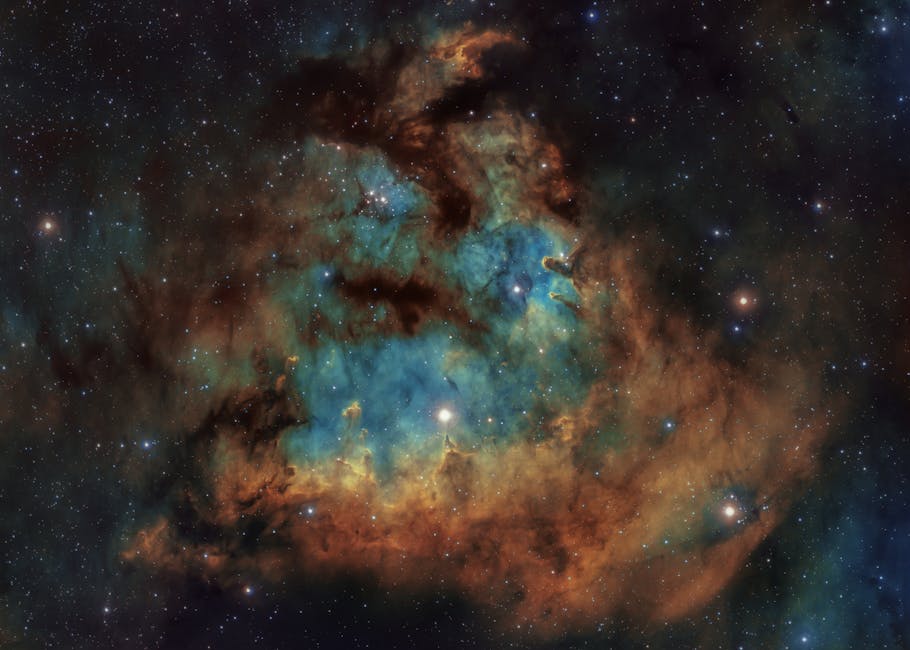
A century later, Einstein's spacetime waltz gets its first encore.
Picture Albert Einstein patiently waiting over a century for the universe to deliver proof of his gravitational predictions. One imagines him muttering in German about cosmic tardiness while swirling an imaginary cup of coffee. The universe, always fashionably late, finally showed up with receipts this week.
A team led by Chinese astronomers observed something extraordinary near a black hole 500 million light years away. A star shredded by gravitational forces created an astrophysical laboratory. As debris spiraled into the void, the resulting accretion disk wobbled rhythmically like a drunk hula hoop artist. This cosmic quivering matched the cadence of jets spewing matter at near light speed. The synchronization provided smoking gun evidence for frame dragging, a phenomenon where spinning massive objects twist the fabric of spacetime around them.
The universe seems perpetually amused that humans require decades or centuries to confirm what it considers obvious physics. Einstein mathematically described frame dragging in 1913, Josef Lense and Hans Thirring refined the equations by 1918, and astronomers only just caught the effect in action. For scale, this timeline makes sloths look like Formula One racers.
The phenomenon demonstrates spacetime isn't just a passive backdrop. Rotating black holes warp it into a dynamic whirlpool, dragging nearby objects along for the ride. Imagine spinning a bowling ball in molasses. The sticky spacetime analog distorts in response to rotation, influencing everything caught in its gravitational syrup. This experiment of stellar destruction, cataloged as AT2020afhd, delivered the clearest observation yet of this cosmic molasses effect.
Researchers studied rhythmic X-ray flashes using NASA's Swift observatory and synchronized radio pulses from the Very Large Array in New Mexico. The 20-day oscillation period revealed the accretion disk and relativistic jet wobbling in unison. Previous tidal disruption events maintained steady emissions, making this variable signal particularly significant. It suggests the entire system precesses that'shakes like Jell-O on a washing machine.
Dr. Cosimo Inserra from Cardiff University, who co-authored the Science Advances paper, noted this proves Einstein right again. Black hole physics often feels like repeatedly checking that gravity still works. Yet each confirmation expands our understanding. The wobbling disk behaves like a playground carousel spun by spacetime itself. Matter gets whipped around not just by gravity but by the rotating gravitational field generated by the black hole. Scientists compare this to magnetism created by moving electric charges. In this case, spinning mass creates a gravitomagnetic field twisting surrounding space.
What makes this discovery impactful beyond theoretical physics? Frame dragging offers a new tool to study black hole properties. Astronomers can't directly observe black holes. They infer characteristics from interactions with visible matter. The precession frequency gives precise data about spin rates, event horizon dynamics, and accretion mechanics.
Consider practical applications of Einstein's theory. Global positioning systems already account for general relativity effects. Atomic clocks on satellites tick faster than Earthbound counterparts due to gravitational time dilation. While frame dragging currently lacks terrestrial applications, understanding spacetime mechanics could prove crucial for future technologies. Spacecraft navigation near massive objects might one day require calculating these distortions.
The Cardiff and Chinese Academy of Sciences team modeled emissions across electromagnetic spectra. Spectroscopy analyzed elemental composition and velocities within the debris disk. Mathematical reconstructions revealed how spacetime warping altered emission patterns. Researchers essentially reverse engineered the black hole's spin from the death spiral of its stellar meal.
This discovery arrives amid renewed interest in extreme gravitational environments. The Event Horizon Telescope captured the first black hole images in 2019. Gravitational wave detectors routinely observe collisions between compact objects. Each technological leap provides fresh angles for testing relativity.
Yet pressing questions remain unanswered. How universal is frame dragging among supermassive black holes? Does this phenomenon influence galaxy formation? Could quantum gravity effects modify these predictions at event horizons? Every answer spawns new inquiries, which explains why astrophysicists enjoy steady employment.
The timing offers poetic symmetry. Researchers identified the tidal disruption event AT2020afhd during Earth's pandemic lockdowns. While humans faced unprecedented terrestrial challenges, a star met its demise in spectacular fashion half a billion years ago. Light from that cataclysm reached sophisticated detectors just as civilization needed cosmic distractions.
Black hole physics frequently resembles mythological storytelling. Invisible beasts lurk in cosmic shadows warping spacetime, consuming stars, and bending light. Einstein fills the prophet role, foreseeing cosmic truths that mortal instruments took generations to verify. Every confirmed prediction strengthens confidence in relativity while highlighting its incomplete nature. Quantum mechanics and relativity stubbornly refuse unified reconciliation.
The universe maintains strict quality control regarding its rule book. Frame dragging observations provide another successful stress test for Einstein's framework. Scientists eagerly anticipate failures in general relativity predictions, which would indicate new physics. So far, relativity keeps passing exams with honors.
Pragmatically, studying spacetime whirlpools advances astrophysical knowledge. Measurements confirm black hole spins influence jet formation and energy output. Understanding these mechanics helps explain why some galactic cores become active while others remain quiescent. Those jets pumping out plasma near light speed influence star formation and interstellar chemistry across galaxies.
This research validates the viability of studying extreme gravity through tidal disruption events. Each star destroyed near a black hole provides brief but information rich fireworks displays. Astronomers now know to look for fluctuating X-ray and radio signals as signatures of precessing systems. More examples will clarify whether AT2020afhd represents typical behavior or a special case. Given sufficient observations, they could create classification systems for disruption events based on spin interactions.
For astronomy enthusiasts, the discovery matters beyond academic curiosity. It confirms the universe operates according to comprehensible principles. A person with sufficient mathematical training can predict spacetime distortions near rotating masses. That such predictions hold true 500 million light years away feels almost miraculous. It suggests physical laws remain consistent across vast cosmic distances and timescales, enabling meaningful exploration of the universe.
The paper's authors use seasonal metaphors given its December publication timing. They reference festive stargazing while discussing spacetime whirlpools. Such analogies highlight science's dual nature, requiring meticulous calculation while inspiring childlike wonder.
Current astrophysical tools continue surpassing expectations. The Very Large Array detected radio oscillations from across intergalactic space. The Swift telescope monitored X-ray fluctuations invisible to Earthbound observers. Future instruments like the Square Kilometer Array and James Webb Space Telescope promise even finer resolution. Perhaps they'll capture frame dragging around neutron stars or white dwarves.
One wonders how frequently frame dragging occurs unnoticed. Every rotating massive object theoretically produces this effect. Earth itself twists spacetime around itself, though the distortion remains undetectably faint. The Gravity Probe B satellite attempted measurements in 2004, achieving only margin of error confirmation. Black holes provide natural laboratories where these effects amplify to observable levels.
This discovery also has philosophical implications. Space and time aren't distinct absolute entities but malleable dimensions intertwined by gravity. Matter tells spacetime how to curve, and spacetime tells matter how to move. Frame dragging exemplifies this interaction with rotating matter dragging spacetime along with it.
Repeatedly testing foundational theories remains science's greatest strength. While online discourse drowns in unverified claims, physics methodically checks its work across generations. Einstein's theories survive through predictive power and relentless scrutiny. Observations like this wobbling star highlight science as self correcting intellectual enterprise instead of static dogma. The process continues indefinitely, steadily refining explanations.
So what comes next? More tidal disruption event monitoring certainly. Larger statistical samples will determine if coprecession between accretion disks and jets represents common behavior. Refined models could predict precession frequencies based on black hole masses and spins. Astrophysicists might develop spacetime seismology, detecting vibrations in gravitational fields.
The discovery won't revolutionize consumer technology overnight. However, fundamental physics breakthroughs historically precede paradigm shifts. Understanding electromagnetic theory eventually enabled global communications networks. Quantum mechanics laid groundwork for semiconductors. Frame dragging insights may one day underpin technologies we can't conceptualize today.
For now, scientists celebrate a century old confirmation underscored by careful observation. The paper ends with poetic musings about nature's variations. Humanity keeps expanding its cosmic perspective, using mathematics, physics and engineering to reach beyond solar system boundaries. This particular investigation reminds us the universe remains the ultimate experimental laboratory.
 By Tracey Curl