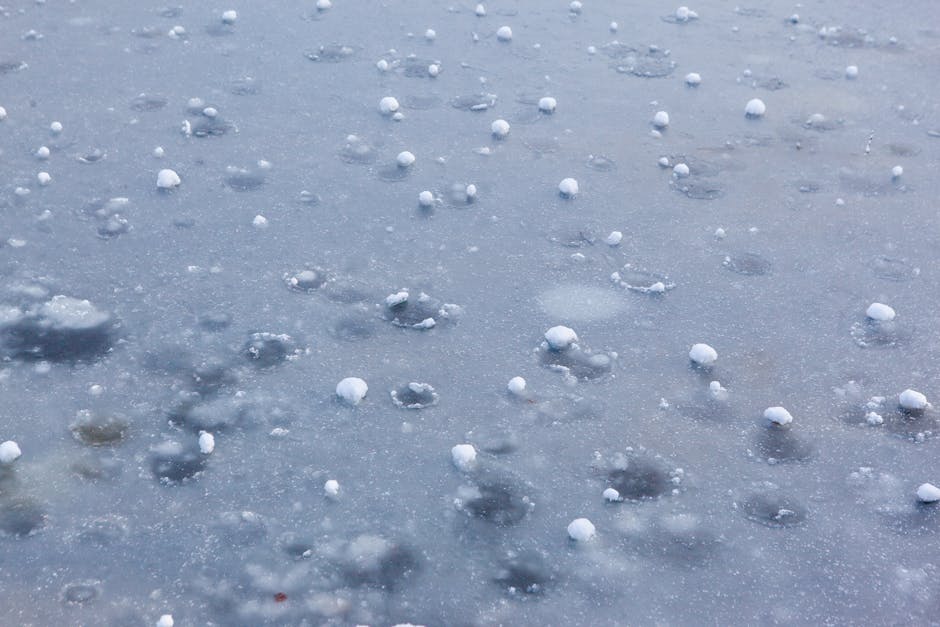
Winter's deepening voice speaks through whirling snow, asking if we're truly listening
The fat flakes falling on Chicago aren't just snow. They're ice crystals whispering secrets from the upper troposphere, carrying messages about temperature gradients and ocean currents and jet stream wobbles that most of us never pause to decode. When we see semi trucks stranded on Iowa highways or flight cancellations stacking up at O'Hare, we're witnessing the surface drama. But below the travel alerts and school closures runs a quieter story—one about humanity dwelling in the path of atmospheric processes we're only beginning to understand.
Here's something remarkable the snowplow driver never mentions. Each ice crystal landing on Buffalo originated as water vapor lifted from the Gulf of Mexico by an updraft precisely calibrated to balance temperature, humidity, and pressure forces. That vapor condensed around microscopic dust particles swept northward from Texas cattle ranches or Saharan dust storms. These tiny jewels then grow arms in minus twenty Celsius air pockets, forming fractal geometries before tumbling earthward through turbulence we couldn't predict three days ago.
Now multiply that times billions. A typical winter storm transports four to five billion tons of water equivalent. This week's bomb cyclone—dramatic name for a storm that drops twenty four millibars of pressure within twenty four hours—likely moved double that. All that energy twirling counterclockwise around a developing low pressure center, like cosmic scales rebalancing heat deficits between land and sea.
Yet our response remains peculiarly human. We salt roads, deploy plows, check weather apps, and grumble about flight delays. The deeper relational tension continues unattended—how our fossil fueled civilization actively reshapes the very systems generating these storms while remaining fundamentally vulnerable to their effects.
Consider three overlooked angles as Midwesterners shovel their driveways for the third time this week. First, the physics behind bomb cyclones reveals nature as relentless innovator. When cold continental air slams into warmer oceanic moisture—as happened this week—the resulting temperature discontinuity creates ideal conditions for explosive cyclogenesis. The storm becomes its own engine, amplifying through baroclinic instability until snowfall rates exceed two inches per hour in some regions.
Second, historical snow records whisper cautionary tales about climate narratives. Chicago's snowiest November day coincided with a weeks long early chill in 1895. Yet 2025's record comes amid an otherwise warming trend, demonstrating winter's tendency toward volatility rather than disappearance. Researchers increasingly observe warmer atmosphere holding more moisture, potentially intensifying snowfalls even as winters shorten.
Third, cultural memory erodes faster than infrastructure rusts. Our great grandparents maintained elaborate winter coping mechanisms—barn shelters for stranded travelers, neighborhood ice harvest teams, pantry storage for multiweek isolation. Urbanization and digital immediacy bred false confidence in our independence from seasons. Now we see semi drivers stranded for hours beside high speed internet connections, longing for basic physical shelter.
The forming ice in Pennsylvania's Pocono Mountains this week illustrates another meteorological poetry. Freezing rain occurs when subfreezing surface temperatures get overlaid by a shallow warm air layer aloft. Snowflakes melt into raindrops, then refreeze upon hitting cold ground objects. The resulting glaze resembles nature's varnish, coating twigs and power lines in deceptive beauty. Meteorologists call this a warm air advection scenario. It sounds far gentler than the reality of black ice chaos.
Scientists still don't fully understand why mid latitude cyclones sometimes undergo rapid intensification while others fizzle. We measure what we can—sea surface temperatures, upper level divergence, vorticity maxima—and make statistical predictions. But somewhere between computational models and nature's execution lies irreducible wildness. This storm deepened fifty percent faster than projected between Sunday night and Tuesday morning, catching many forecasters off guard.
Now recall the quiet scientific revolution shaping our storm predictions. The European Centre for Medium Range Weather Forecasts incorporated new gravitational wave drag calculations into their models last year. These high atmosphere ripples, generated by airflow over mountains and thunderstorms, influence jet stream behavior. Contemporary five day forecasts now match three day forecasts from 1990 in accuracy. Yet Saturday's Chicago surprise proves predictability limits remain firm.
Irony tastes sharp here. We developed satellite networks and supercomputers capable of modeling ice crystal growth phases, yet cannot guarantee whether Boston's morning commute might bring slush or disaster. Urban emergency planners quietly calculate acceptable risk levels for school bus routes and hospital generator fuel reserves, knowing perfectly well that statistical safety margins provide false comfort when freezing rain arrives six hours early.
The most poignant human moments happen off camera. Elderly couples deciding whether to risk icy sidewalks for medication. Nurses trading childcare duties when schools close unexpectedly. Migrant workers realizing temporary roofs offer little insulation against minus ten wind chills. No smartphone app alleviates these raw physical dilemmas.
Powerful contradictions emerge. We increasingly see winter storms through climate crisis lenses, yet historical records show similar volatility pockets throughout the 20th century. We blame carbon emissions for atmospheric disruption, yet industrialized snow removal burns thousands of gallons of diesel per hour. We feel entitled to rush across frozen landscapes whose very conditions required generations of protective adaptation.
Perhaps our ancestors possessed wisdom we've misplaced. Indigenous peoples from Labrador to Lake Superior maintained detailed oral storm libraries, passed down through generations with survival instructions. Historians documented Aroostook County lumber camps where men engineered feats like ice reinforced log bridges that modern engineers struggle to replicate. Today we deploy chemical deicers that corrode bridge cables while weakening concrete.
Technology offers one kind of progression, but another type of intelligence atrophies without practice. Children once learned to read subtle drifts patterns indicating hidden ice patches. Farmers trained eyes to detect telltale cloud formations preceding blizzards. Such place based literacies fade when weather apps homogenize forecasts across regions with profoundly different microclimates.
The storm now departing Atlantic Canada stirs reflections beyond today's shovel fatigue. Beneath questions about school delays and flight cancellations lies an enduring planetary truth. Earth maintains equilibrium through heat exchanges at its hemispheric boundaries. Our cozy houses and efficient airports cling like temporary shelters along atmospheric rivers we neither control nor fully comprehend. Maybe that's the finest lesson wrapped within these snowflakes—humility before elemental forces we must respect to survive.
 By David Coleman