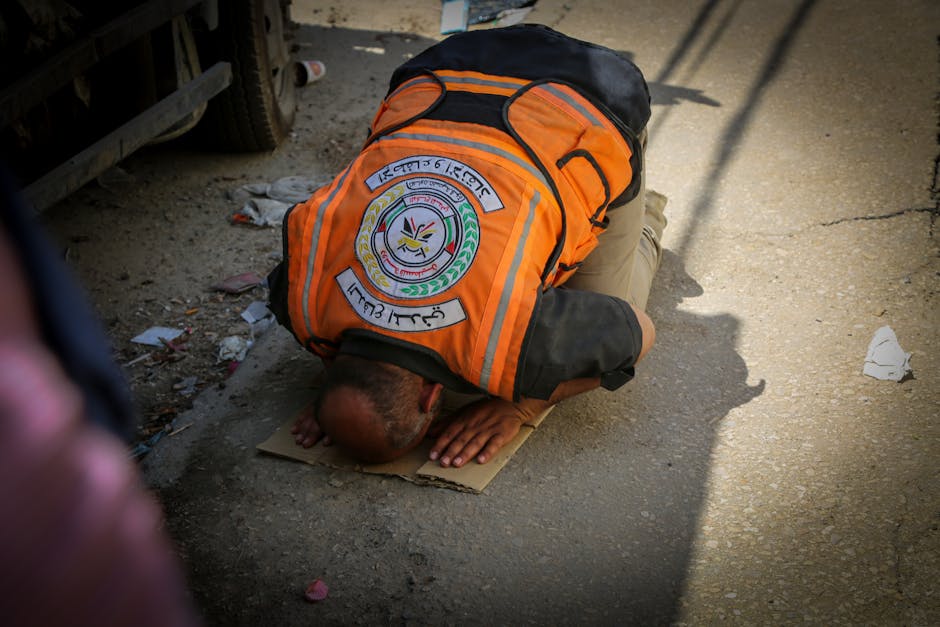
Death notices and detentes in the desert sun
There's an old magician's trick where you make a dove disappear only to produce it elsewhere moments later. The audience claps while quietly suspecting it's probably not the same dove. Watching ceasefire agreements unfold in the Middle East provokes similar suspension of disbelief in grown adults. Those doves get around.
The recent incident involving a senior Hamas commander's death via precision strike has less to do with explosive innovations and more with painfully familiar patterns. Militants move, intelligence follows, someone presses a button in an air conditioned room. The car disintegrates. Apologies are issued or withheld. Families mourn. Diplomats scurry to determine whether this qualifies as a "disruption" or "routine maintenance" of the peace process.
What's fascinating isn't the tactical dance itself but the theater required to sustain the illusion that ceasefires freeze conflicts rather than slightly lower their volume. Both sides now wield accusations of truce violation like duelists counting paces. One step back, two steps sideways, sudden flurry of motion when nobody's looking directly at the stretch of sand in question. The script hasn't changed since trebuchets gave way to Twitter.
Consider the messaging in play. Hamas frames the commander's death as civilian targeted violence. Israel provides dossier style proof of militant activity. International observers perform triage on truth claims. Social media amplifies the muddle until clear narratives look like Rorschach tests. In this environment, the attack becomes less about eliminating threats than about whose ideological filters get to apply the color correction.
Human toll remains the least contested element. Four men buried underground while their comrades dig metaphorical trenches above. Thousands watching Gaza's reconstruction move at the speed of bureaucratic treacle. Billions pledged, millions delivered, actual impact measured in temporary shelters and communal trauma. We focus on the spectacular strikes but miss the creeping devastation of markets that can't reopen, children who can't find classrooms, and antibiotics that can't pass through checkpoints.
The broader implications deserve unpacking. Assassinations historically serve either deterrence or provocation purposes. Context determines which outcome emerges. Current conditions fertile ground for the latter. When resistance movements perceive decapitation attempts as existential threats rather than occupational hazards, recruitment posters write themselves. Equally, security states see every hesitation as vulnerability. This creates incentives resembling a demolition derby with peace treaties duct taped to the bumpers.
Observers often underestimate Hamas's organizational elasticity. The group blends political governance, social services, and paramilitary wings with startling resilience. Targeting key figures produces succession planning rather than collapse. Understanding this morphic quality matters more than counting casualties when projecting long term outcomes. Hydras don't falter because one head gets lopped off, they regrow two more utilizing existing biological infrastructure. Metaphors only hold so far before biology becomes ideology.
Israel's security calculus operates on different wavelengths. Preventive action against perceived existential threats defines policy since statehood. Precision strikes offer cleaner alternatives to ground invasions. Handwringing about proportionality rarely factors into defensive algorithms developed across generations of conflict. What outside critics frame as aggression appears domestically as essential maintenance. This perceptual gap explains why international condemnations often harden Israeli positions rather than softening them.
Meanwhile, the political dimension simmers. Hamas reminding the world that Palestinians alone choose their leadership sounds redundant until you recall how often foreign policymakers forget this basic democratic tenet. History remains littered with regimes propped open like malfunctioning garage doors because external players preferred friendly authoritarians over unruly representatives. Sovereignty rarely survives contact with great power interests.
No serious discussion occurs without acknowledging reconstruction paralysis. Gazans endure housing scarcity, medical supply shortages, and contaminated water while political factions debate whose logo appears on aid shipments. Local administrators parse grant conditions under flickering lights aware that skirmishes can erase progress monthly. This breeds despair lucrative for extremism. Certain parties understand this dynamic intimately.
Paths forward exist despite gloom. International aid requires insulation from political fluctuations. Developing independent Palestinian civic institutions weakens the monopoly of armed factions. Incentives for economic cooperation could slowly replace deterrence as conflict management tools. None offer quick fixes. All demand commitments beyond election cycles and attention spans.
Ultimately, ceasefires serve punctuation purposes in unfinished sentences written by generations of warriors and diplomats. The latest tragedy merely inserts another semicolon where participants hoped for a period. Until civilian flourishing becomes the metric overriding casualty counts, the doves will keep flying south whether we applaud their disappearance or not.
 By George Oxley