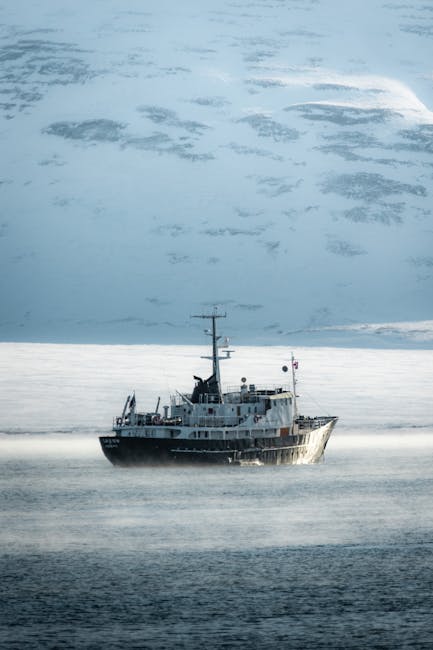
Beneath the shivering cold, Earth whispers secrets of survival and change.
There is a particular quality to deep cold, a silence that settles over everything like a physical presence. I remember stepping outside one February morning years ago, the thermometer reading minus twenty Fahrenheit. The air felt sharp against my cheeks, each breath crystallizing in my scarf. The snow squeaked underfoot with an almost musical pitch, the moisture frozen out of it completely. Today, as similar conditions descend across the Midwest and East Coast, countless people will experience this eerie quiet disrupted only by the groan of old house timbers contracting and the brittle snap of frozen tree branches.
Meteorologists speak of a displaced polar vortex, that great swirling mass of Arctic air usually contained near the pole. Its expansion pushes frigid air southward in pulses, creating what forecasters call a triple dip event this year. We hear these terms and nod, imagining some cosmic faucet unleashing northern winds. But there is more wonder here than we acknowledge. The polar vortex is not some invading force but an ever present climate feature, behaving exactly as physics dictates. Its movements reflect intricate interactions between atmospheric layers stretching nearly 80 kilometers upward, jet stream undulations written across continents, and subtle temperature differences measured in fractions of a degree.
Consider the organisms who thrive where we merely endure. On Arctic ice floes, microscopic algae bloom in minus thirty degree darkness, producing pigments that act as natural antifreeze. The woolly bear caterpillar freezes solid every winter, its heart stopping completely as ice forms between its cells, only to thaw and resume life come spring. Meanwhile, humans huddle indoors, our biological limitations starkly exposed. Our predicament highlights an uncomfortable truth. For all our technological prowess, we remain tropical mammals poorly equipped for extremes. Our ancestors knew this well. The Finnish practice of cold water immersion after saunas, the Inuit tradition of constructing snow houses, all speak to cultural adaptations born from honest reckoning with our physical vulnerability.
Three scientific insights reshape our understanding of these cold snaps. First, the surprising role of microscopic life in cloud formation. Every snowflake begins with an ice nucleating particle, often a grain of dust or a bacterium like Pseudomonas syringae, microbes evolved to trigger ice crystallization. These tiny architects influence weather patterns on continental scales. Second, recent studies reveal that rapid Arctic warming may paradoxically intensify winter cold outbreaks elsewhere. As sea ice retreats, it alters atmospheric pressure patterns, potentially weakening the jet stream's stability. Last, research into hibernation mechanisms shows potential medical breakthroughs. By studying how Arctic ground squirrels lower their body temperature to near freezing during hibernation without tissue damage, scientists explore ways to induce protective hypothermia in trauma patients.
The cold also reshapes the very ground beneath us. Frost quakes, or cryoseisms, occur when water saturated soil freezes rapidly, expanding with such force that it fractures rock layers with explosive booms loud enough to rattle windows. These geological events remind us that temperature changes translate into physical stresses far beyond human perception.
Yet our response remains peculiarly contradictory. We heat homes excessively until indoor air becomes as dry as desert winds while battling ice dams on our roofs. We pave our cities in dark asphalt, creating urban heat islands that intensify winter rains followed by flash freezes. Each winter storm brings flurries of advice about emergency preparedness, yet collectively we build power grids vulnerable to ice accumulation and homes with inadequate insulation. The underlying tension here is revealing. We seek dominion over nature while remaining subject to its laws, a paradox as old as civilization itself.
Beyond physical adaptations, cold shapes cultural memory in profound ways. Scandinavian cultures speak of koselig, roughly meaning cozy, describing the heightened sense of community and contentment found in shared warmth against the outer chill. Japanese poets perfected the art of fuyu no uta, winter poems celebrating subtle seasonal transitions like the first ice crust forming on a pond. Contrast this with America’s predominantly adversarial view of winter as something to overcome rather than harmonize with.
There exists a poignant connection between bitter cold and human warmth. When blizzards knock out power, neighbors share generators. Stranded travelers find shelter with strangers. People check on elderly relatives with renewed diligence. The hardship strips away superficial concerns, revealing what truly matters community, shared vulnerability, simple acts of kindness. Perhaps this is winter’s gift not merely snowscapes to admire but regular reminders of our interdependence.
As you listen to the wind tonight, consider water’s strange behavior at freezing point. Unlike most substances, water expands as it solidifies, creating ice’s crystalline latticework. This anomalous expansion shapes our world, from frost flowers blooming on lake surfaces to the weathering of mountain ranges. In this peculiarity lies life’s possibility ice floats, insulating liquid water below so life survives winter’s grip. The atmosphere mirrors this duality, temperature gradients powering weather systems that distribute heat across the planet. Cold never exists in isolation, only as part of a ceaseless thermal conversation between equator and pole, atmosphere and ocean.
Naturalist Bernd Heinrich, studying ravens in Maine winters, documented how these intelligent birds survive minus forty degree nights. They fluff their feathers to trap insulating air, tuck specialized foot scales to minimize heat loss, and gather in communal roosts to share warmth. Their winter survival depends not just on biology but learned wisdom passed across generations. As climate patterns shift, challenging animals to adapt to unfamiliar extremes, humans face parallel questions about what ancestral knowledge we carry forward and what new resilience we must cultivate.
Perhaps the deepest revelation comes from tardigrades, microscopic water bears surviving even space’s vacuum by entering cryptobiosis, expelling nearly all water from their cells. Frozen for decades, they revive when thawed. While humans lack such extreme resilience, we possess cultural cryptobiosis stories, technologies, and relationships preserved through life’s winters, ready to regrow when conditions ease. This current cold snap may pass in weeks, but Earth’s broader temperature fluctuations unfold across millennia. How might our present struggles appear when placed in such vast perspective?
Tomorrow morning, should you find frost feathers decorating your windows, take a moment to admire their fractal perfection. Each feathery ice crystal traces the air’s hidden currents, humidity variations, and imperfections on the glass surface, unique patterns emerging from universal physical principles. Like weather systems, like human communities responding to crisis, beautiful complexity arises from simple interactions, one frost particle bonding to another. The cold asks us to witness, to adapt, and ultimately to remember we remain participants in ancient conversations between air and earth, warmth and chill, separated not from nature but moving through its many seasons together.
 By David Coleman