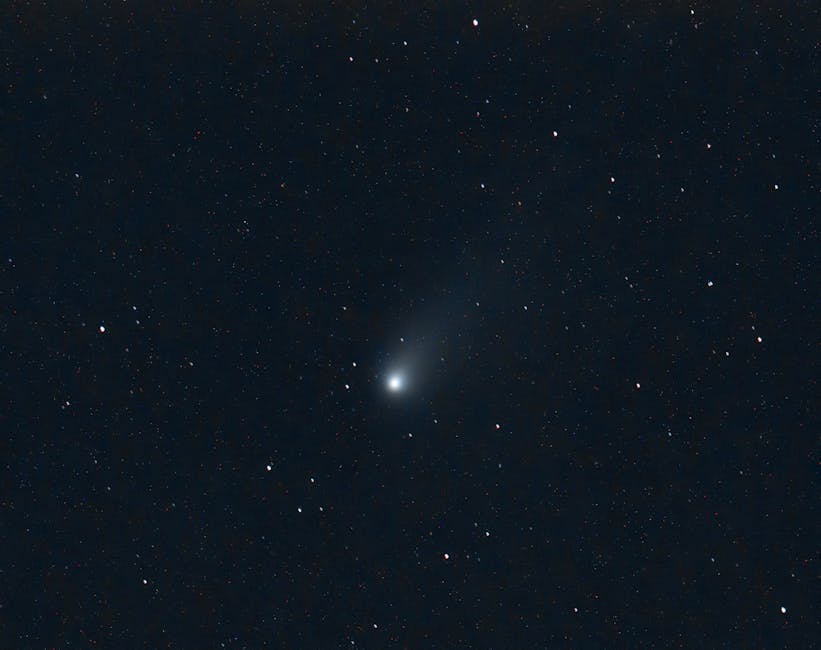
A cosmic snowball from another star system drops in unannounced.
Earth finds itself in the celestial equivalent of receiving unexpected galactic mail this week as comet 3I ATLAS makes its closest approach to our planet. This particular chunk of ice and dust holds special significance because it hails from beyond our solar system, making only the third such confirmed interstellar visitor in recorded human history. At its nearest point, the comet will remain roughly 168 million miles away, a perfectly polite distance that ensures no meaningful risk while still permitting scientific observation.
The cosmic snowball currently speeding through our neighborhood first drew attention when detected by the Asteroid Terrestrial impact Last Alert System in 2023. Unlike ordinary comets tracing elliptical orbits around our sun, 3I ATLAS follows a hyperbolic trajectory that mathematics confirms originated outside our solar system. This fundamental distinction transforms what might otherwise be just another icy visitor into a rare specimen delivery service from interstellar space.
Public fascination with interstellar objects stems from both their novelty and scientific potential. Each such visitor carries encoded information about the chemical composition and physical processes occurring in distant star systems. When comet Borisov passed through in 2019, researchers discovered it contained unusually high amounts of carbon monoxide, suggesting formation in extremely cold regions compared to our solar system's comets. The famous elongated visitor Oumuamua in 2017 sparked extended debates about its unusual acceleration and shape, though most evidence points to natural rather than artificial origins.
Among professional astronomers, 3I ATLAS generates excitement primarily through its cooperative timing and position. Unlike its predecessors detected mid journey or on departure, this comet announced itself early enough for multiple observation platforms to coordinate detailed studies. The Hubble Space Telescope captured visible light images, while the Jupiter bound JUICE spacecraft deployed its instruments in an opportunistic observation campaign. Ground based radio telescopes worldwide have monitored emissions from sublimating gases, creating a three dimensional profile of the comet's chemical outgassing.
Public livestreams promising comet viewing face certain unavoidable truths of observational astronomy. Small fuzzy dots against black backdrops rarely match cinematic expectations, and light pollution often renders urban viewers moon faced and empty handed. The theoretical visibility of interstellar visitors frequently bumps against the practical limitations of consumer grade optics. Even through backyard telescopes exceeding $1000 in value, 3I ATLAS currently presents as little more than a dim, diffuse smudge lacking the dramatic tails adorning astronomy magazine covers.
This gap between scientific enthusiasm and public experience reveals an enduring tension in astronomy communication. Significant resources get devoted to tracking objects like 3I ATLAS because they offer unique research opportunities, not because they put on visually spectacular shows. Public observatories and science institutions must balance inspiring wonder with managing expectations, attempting to convey the true significance of faint pixels in telescope feeds while acknowledging they don’t exactly resemble Hollywood comet depictions.
The arrival of interstellar comets highlights persistent underinvestment in sky surveying infrastructure. Current detection systems primarily focus on identifying asteroids that might actually threaten Earth, with interstellar object detection remaining an incidental benefit. Dedicated telescopes specifically designed to spot these fast moving visitors could greatly increase discovery rates, but such proposals compete for funding against more practical or headline grabbing projects. Each confirmed interstellar object offers otherwise unavailable data about the prevalence and diversity of planetary systems across our galaxy.
Amidst monitored airspace and orbit tracked satellites, interstellar comets serve as reminders that Earth remains subject to uncontrolled cosmic traffic. While current interstellar objects pose no impact risk, their presence demonstrates that planetary systems naturally exchange material via gravitational interactions with passing stars. Current models suggest dozens of interstellar objects likely pass within Neptune's orbit annually, the vast majority too small or dark for detection. Future telescopes may reveal this hidden population, fundamentally altering our understanding of the solar system's boundaries.
The diligent tracking of 3I ATLAS underscores astronomy's awkward position between pure research and public spectacle. Scientists extract meaningful data from subtle spectral lines and trajectory refinements. Media outlets package press releases about cosmic visitors into attention grabbing headlines. Enthusiasts hope for backyard visibility that rarely materializes. Meanwhile, the comet itself continues along its determined path, completely indifferent to terrestrial classifications or designated flyby dates. By mid 2026, even professional observatories will lose sight of it as the fading speck retreats into interstellar darkness, carrying our unanswered questions back into the void.
Persistent amateur participation in tracking such events highlights science's evolving landscape. Online telescope networks now allow enthusiasts worldwide to contribute observations via remote robotic instruments, while distributed computing projects enable home users to assist in data analysis. The detailed path mapping of 3I ATLAS incorporated hundreds of smaller observatory measurements alongside major facility data. This collaborative approach marks how modern astronomy increasingly operates as a global network rather than isolated ivory tower institutions.
As telescopes improve both on Earth and in orbit, the coming decades will likely yield regular interstellar visitor detections. Each will be scrutinized for signs of strange chemistry or unexpected structure that could reshape theories of planetary formation. Future missions may even consider interceptors designed to rendezvous with these high speed travelers before they depart the solar system, though such missions require launching spacecraft with remarkably short notice. For now, humanity remains limited to waving metaphorical handkerchiefs as interstellar guests pass through our celestial front yard on their way elsewhere.
 By Tracey Curl