Touching another world demands we face what it means to be alive
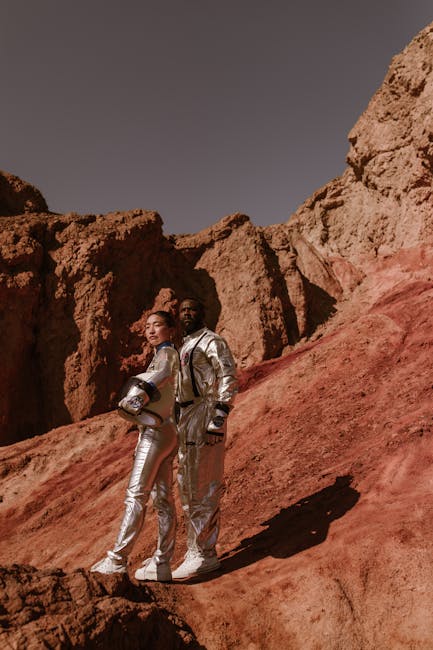
Consider for a moment the color. Not the rusty oranges NASA’s rovers show us through their mechanical eyes, but the actuality of light bending through alien air filtered onto human retinas. When astronauts finally stand within a Martian crater basin, breathing recycled air, their visors will frame horizons tinged a pink so misaligned with Earthly dawns it might rearrange synaptic pathways. To see sunset where no tree has ever cast a shadow is to experience sublime disorientation. No machine can ever convey that strangeness back to us properly.
Recent discussions among scientists about sending humans to Mars orbit around practicalities, as they should. The National Academies report rightly emphasizes search protocols for microbial life, dust mitigation strategies, and interplanetary contamination guidelines. Yet layered beneath these vital yet clinical bullet points squirms something primal and unresolved. The magnetic tug of that crimson desert pulls not just at budgets and rocket schematics but at our deepest philosophical moorings.
We all know the robotic rebuttal by now. Why risk fragile human lives when Perseverance drills so diligently. Why fund years long expeditions when orbiters map mineral deposits with such pixelated precision. The counterargument always circles back to improvisation, intuition, the irreplaceable spark of consciousness interacting with environment. But this misses the more unsettling reason. We do not go to Mars for efficiency. We go for the same reason children poke sticks into anthills, prodding the universe to prod us back. To discover whether life ever stirred in those dusty riverbeds isn’t merely science. It is ceremony.
Consider three overlooked truths about our Martian longing. First, the granular intimacy of contamination. Martian regolith contains toxic perchlorates lethal to human cells, yet equally our microbes might devastate potential native organisms in ways robots wouldn’t. This cuts both ways. Any astronaut scooping soil samples might unwittingly crush fossilized evidence under boot treads, or perhaps worse, become patient zero for Martian pathogens their immune system cannot fathom. The drama of infection plays differently when the microbe itself represents alien biology.
Second, the psychological chiaroscuro emerging in recent isolation studies. During NASA’s Hi SEAS Mars simulation in Hawaii, crews displayed remarkable adaptability until minor equipment failures disrupted routines. Then fissures emerged. Crew members eating meals one meter apart stopped speaking. Others became obsessive about inventory control. Mars offers no trees to touch, no wind to feel beyond Hab suits, no biological rhythms beyond artificial lighting cycles. Anthropologists note this mimics symptoms experienced by Antarctic winter over crews, except Mars lacks even the distant possibility of rescue. The silence there isn’t acoustic. It’s existential.
Third, the overlooked tension between exploration ethics and our yearning to belong. Ecopoiesis, the hypothetical process of jumpstarting ecosystems on dead worlds, once belonged strictly to science fiction. Now it gains academic seriousness as we identify lichen species capable of surviving Martian radiation in lab simulations. Where should the line between preservation and domestication be drawn when no visible life exists to preserve? Treating Mars as a pristine museum assumes cosmic loneliness as default. Tempting though it is to view humans as trespassers, perhaps we’re also pollinators.
Walk outside tonight and stare upward. That sherbet dot in the sky is not some abstract destination. It possesses enormous valleys deeper than Earth’s grandest canyons, weather systems that paint the whole planet beige with oxidant laden dust storms lasting months. Yet it also holds what University of Florida researchers confirmed recently when growing radishes in simulated Mars dirt. Life’s grittiness. Just add water, nutrients, and stubbornness. Those tentative roots curling through ersatz regolith carried the same emergent urgency as cyanobacteria first greening Earth’s primordial shores. Vitality always trespasses.
Mars missions won’t happen in sterile labs or Senate appropriations hearings. They will unfold in the ache of muscles atrophying against 0.38g gravity, in the stutter steps of children learning to walk inside rotating orbital habitats, in the bewildered pause before eating food grown in alien soil wondering if it tastes of iron or promise. Elon Musk speaks of making life multiplanetary to avoid extinction. Jeff Bezos dreams of floating space colonies. Stripped of spectacle though, the quieter truth is this. We cannot know what Mars means until we crouch beside an outflow channel, glove brushing sediment layers older than any fossil on Earth, and feel minute tremors of recognition or alienation. Either answer rewrites theology.
No protocol can prepare us for the wonder and terror astronauts may experience if their scoops reveal definite biosignatures. Imagine staring at microscope slides inside a pressurized Hab, seeing unmistakable cellular structures never involving DNA or water based chemistry. Would that revelation trigger euphoria or profound ontological vertigo. Conversely, what if centuries of searching yield only sterile dirt. Does the universe feel roomier or lonelier?
Robots transmit data. Humans make meaning. Our cave paintings and Voyager golden records share the same impulse, etching our presence onto indifferent vastness. When Maria Garcia Hernandez, a geobiologist at Caltech, discovered that certain Earth extremophiles survive simulated Mars conditions by coating themselves in conductive nanowires, she also noted something poetic. These microbes essentially weave tiny lightning rods, grounding themselves against environmental fury. Isn’t that what we do too when we build steel ships against cosmic radiation or stubbornly claim kinship across light years any life we find will likely share this instinct. Not just to survive, but to connect.
The sand gets everywhere, Mars veteran rovers report. Gritty grains jam joints, coat solar panels, infiltrate seals. Future astronauts will curse the static cling of fines clinging to suit liners. They’ll sweep dust out of airlocks with resigned familiarity, write gritty haikus, maybe bottle amber vials beside mission patches. Fifty years from now, that dust might reside in museum displays under glass, our descendants peering at motes that crossed interplanetary space inside sleeve cuffs. Dirty, imperfect, alive. Just like us.
Back to color. After months inside Hab lighting, that first unfiltered glimpse of the Martian horizon will bleed strange wavelengths straight into corneas evolved for African savannas. It might hurt, as new truths often do. But facing pain is what separates explorers from tourists.
 By David Coleman