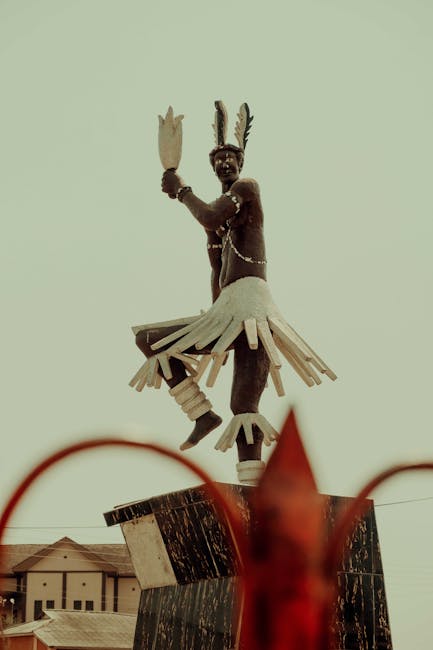
An African visionary redefines the art world's center of gravity
The art world witnessed an unprecedented tectonic shift this week as Ghanaian artist Ibrahim Mahama claimed the apex of ArtReview's influential Power 100 ranking. What might appear as simple listicle news actually represents a cultural watershed moment, comparable to the earthquake felt when Jazz first permeated European conservatoires or when Japanese ukiyo e prints revolutionized Post Impressionism. Mahama's ascendance marks the first time an African creator leads this global ranking, challenging entrenched assumptions about where artistic innovation originates and who gets to shape contemporary discourse.
Mahama's journey from the northern Ghanaian city of Tamale to the summit of ArtReview's hierarchy parallels Africa's complex navigation of postcolonial identity. Born in 1987, just three decades after Ghana became the first sub Saharan nation to gain independence from Britain, Mahama embodies the generational bridge between colonial trauma and autonomous creative expression. His monumental installations using jute sacks, railway relics, and textile fragments do more than repurpose materials, they become forensic examinations of labor systems, trade routes, and collective memory.
When Mahama draped London's Barbican in two thousand square meters of vivid pink fabric last year, the gesture transcended visual spectacle. Those textiles traveled from Ghanaian markets to be stitched together on a Tamale football field, carrying with them the fingerprints of artisans rarely credited in Western gallery wall texts. This inversion of creative pipelines, where labor flows from Global South to Global North rather than vice versa, quietly revolutionized art production economics. Mahama's practice anticipated current debates about ethical sourcing and digital colonialism by nearly a decade.
The Savannah Centre for Contemporary Art, Mahama's sprawling Tamale complex that opened in 2019, might be his most radical work yet. Unlike Western style white cube galleries parachuted into developing cities, this twelve acre ecosystem sustains art education through its archive of over 50,000 books while supporting local metalworkers, tailors, and technicians. Here lies Mahama's true disruption, he's trained over two hundred Ghanaian artisans in conservation techniques, creating sustainable infrastructure that defies the parachute artist model where creators from developing nations are extracted for biennial exhibitions then abandoned.
ArtReview's list acknowledges this holistic approach. The inclusion of Sheikha Al Mayassa bint Hamad bin Khalifa Al Thani at number two underscores how non Western patronage networks increasingly rival traditional European and American art financing. Qatar Museums under her leadership spent $1.3 billion on art acquisitions between 2013 2016 alone, rivaling annual purchases by New York's Metropolitan Museum. Yet Mahama's presence atop these financial titans suggests something more profound than market forces at play, it reflects hunger for artistic visions untethered from Western postmodern fatigue.
This seismic shift recalls earlier art world revolutions, like when 1980s Neo Expressionists shattered Minimalism's dominance or when Murakami's Superflat movement made Japanese aesthetics globally covetable. But those movements still operated within established commercial frameworks. Mahama's emergence matters because it challenges the very geography of cultural validation. His use of discarded train parts from Ghana's colonial era railways, now being reimagined at the Nkrumah University of Science and Technology (where both Obuasi mines engineers and contemporary artists train side by side), represents postcolonial reclamation at industrial scale.
The timing resonates beyond aesthetics. Europe currently returns looted Benin Bronzes to Nigeria, while American museums face pressure to repatriate African artifacts by 2030. Mahama's methodology anticipates this reckoning by creating new works that honor heritage rather than replicating colonial extraction. His 2015 Venice Biennale installation enveloped European architecture in African textiles, a symbolic reversal that gains new potency with this Power 100 recognition.
Critics could argue ArtReview's list merely window dresses systemic inequities. Though African art markets grew 37% between 2018 2022 per ArtTactic data, they still represent less than 1.5% of global auction sales. Western institutions still control exhibition calendars and acquisition budgets. Yet Mahama's rise, alongside peers like Wael Shawky and previous honoree El Anatsui, tracks with deeper movements. The opening this year of Nigeria's Edo Museum of West African Art, designed by David Adjaye to house repatriated works, signals institutional transformation matching market shifts.
Historical context reveals how overdue this moment truly is. Ghana established Africa's first art college in 1922 under British governor Guggisberg, designed to teach European representational techniques. Nearly a century later, Mahama's work exhibits in those former colonizer nations not as derivative mimicry but as visionary truth telling. His 2019 ACCRA exhibition used DNA swabs to trace European surnames forced upon Ghanaian families during colonial registration, blending conceptual art with archival activism.
For young Ghanaian artists like textile collective The Threaded Souls, who collaborate with Mahama's Savannah Centre, this recognition promises tangible change. Suddenly, global curators book flights to Tamale rather than expecting artists to beg for visas. Auction houses that previously ignored West African sales now host dedicated lots. Yet true power lies in Mahama's institutional building, ensuring his legacy outlasts art market trends.
The deeper question remains whether Western establishments will surrender gatekeeping power or merely expand their invitation lists temporarily. ArtReview itself averaged only three African entries annually in its Power 100 before 2020. As Mahama noted, being first African honoree brings pressure to sustain pathways for others. His response is characteristically pragmatic, through the SCCA he's mentoring fifteen emergent Ghanaian artists while cataloguing oral histories from elderly batik makers.
Perhaps this moment's greatest significance lies beyond art world backslapping. Mahama's community embedded practice offers a template for post pandemic cultural renewal globally. As Western museums fire educators while expanding gift shops, his integrated artist archive residency model demonstrates how cultural spaces can remain financially sustainable without sacrificing integrity. The seven hundred local workers currently restoring railway carriages into art installations at Tamale's SCCA prove that distinction between artisan and artist, labor and creativity, needs reexamination.
Ultimately, Mahama's Power 100 coronation matters not for its individual achievement but for its collective symbolism. Like Ai Weiwei's 2011 top ranking spotlighted Chinese dissident art, Mahama's ascent illuminates an entire ecosystem of African creativity too long ignored. His historic accomplishment represents not a singular triumph, but a collective rescripting of who shapes twenty first century aesthetics. As the Savannah Centre's expanding satellite locations in Accra and Kumasi suggest, this is no fleeting moment but the foundation of lasting structural change.
 By James Peterson